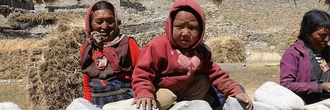
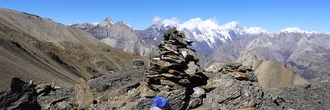
Exploring Dolpo
The DolpoCare team of Swiss doctors visited the Dolpo district several times to get an idea of the medical situation on the ground.
The on-site investigations led to the realization that the hospital in the main town of Dunai in particular is not functional, and that there is a lack of qualified primary medical care in the often inaccessible hinterland north of Dunai and in Upper Dolpo. This insight resulted from numerous interviews with the local population, meetings with hospital staff and local authorities, as well as the know-how of DolpoCare's medical experts.
A detailed report on the health situation in Dolpo can be found under the following link: Report on health situation in Dolpo and support project for Dunai hospital
A brief summary can be found below.
Dolpo in Nepal
Dolpo is a region in north-western Nepal bordering Tibet that is often forgotten by the Nepalese government and non-governmental organizations. The Dolpo region covers an area of 7889 square kilometers, but has only 36,000 inhabitants (4.7 inhabitants per square kilometer).
Dolpo is divided into the Lower and Upper Dolpo. The former lies between 2000 and 4000 meters, the latter mainly above 4000 meters. The division is also due to the fact that the Lower Dolpo is relatively fertile and predominantly Hindu, while the Upper Dolpo is dry and hardly fertile, as well as predominantly Tibetan and influenced by the Bon religion.
Standard of living in Dolpo
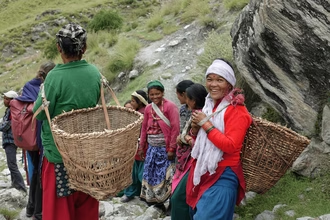
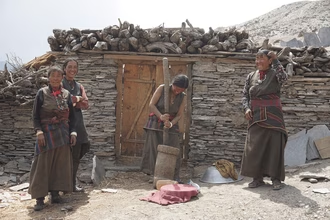
The standard of living varies greatly depending on the location in Dolpo and is lower in the inaccessible and dry Upper Dolpo than in the more fertile Lower Dolpo. Various types of vegetables, cereals and rice are mainly grown there, while livestock farming and barley cultivation predominate in Upper Dolpo. All work is mainly done manually.
A major source of income in summer is the harvest of the Yartsa Gunbu mushroom (= Viagra of the Himalayas), which grows in a caterpillar and can be sold at top prices. The income from tourism is limited, as only around 600 to 1000 tourists travel to Dolpo each year, and they usually bring their tour guides with them from Kathmandu, which means that the majority of the income does not remain in Dolpo.
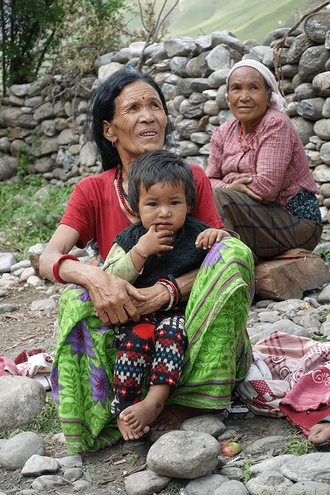
Part of the population of Upper Dolpo trades in goods with Tibet. The houses there have a strong Tibetan character, are made of stone and wooden beams and are not insulated. Dried yak dung is used as fuel, and solar energy is also increasingly being generated. The sanitary facilities in most houses consist of an outhouse with a bucket of water; showers are largely absent.


Road infrastructure in Dolpo
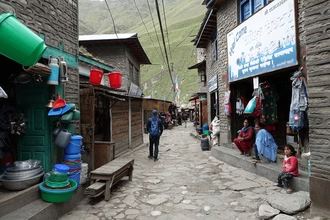
To date, there is no continuous road connecting Dolpo with the rest of Nepal. The paths in Dolpo are mule tracks, comparable to our mountain hiking trails. These paths pose a great danger of falling, especially for the elderly population of Dolpo.
Dolpo can therefore only be reached on foot from the town of Nepalgunj, or by plane in sunny weather until before ten o'clock in the morning; after that, there are usually strong winds that make air travel impossible. During the monsoon season from June to September, flights are often impossible for weeks.
Goods are transported by porters, horses, mules or yaks. A road link is currently being built from western Tibet via Dolpo to Dho Tarap and on to India.

Lack of medical infrastructure in Dolpo
There is no continuous health care system that covers all sections of the population in Dolpo. However, there are a number of NGOs scattered throughout Dolpo that offer basic medical care at a low level regionally. There is no comprehensive coordination of all these NGOs and the Nepalese government makes little to no coordination efforts.
According to the law, the Nepalese healthcare system is hierarchically structured with university, district and regional hospitals, but the government's arm does not reach into remote regions such as Dolpo. In addition, there is still considerable corruption, which makes cooperation with Nepalese authorities even more difficult, as there is often a lack of suitable contact persons. We experienced this with the example of the only hospital in Dolpo in the main town of Dunai: on paper it is functional, but during our visit and in discussions with local doctors and other health professionals we came to the opposite conclusion.
There are various health posts scattered around Dolpo where paramedical staff provide basic medical care. Laboratories and other examination facilities are lacking, diagnoses are made empirically and therapies are hardly evidence-based. Evacuations of seriously ill patients are practically impossible due to the transportation routes and remoteness. A concrete, feasible opportunity for improvement therefore lies in the expansion of health posts, which is a declared goal of DolpoCare.
Most common health problems in Dolpo
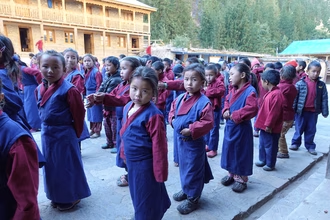
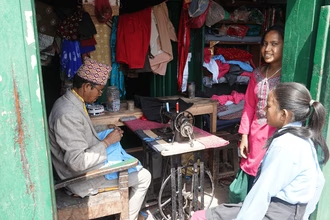
What is common throughout Nepal is also common in Dolpo: Respiratory infections, skin problems such as eczema, scabies due to poor hygiene, gastrointestinal infections with diarrhea. There are also cases of tuberculosis and chronic respiratory diseases due to smoke emissions in the kitchen. Many diseases cannot even be diagnosed, let alone adequately treated, due to limited diagnostic and human resources.